MHRA Patient Hoist Safety Alert 2026: Care Provider Actions
MHRA Patient Hoist Safety Alert 2026: What Care Providers Must Do
On 16 September 2026, the Medicines and Healthcare products Regulatory Agency (MHRA) issued a National Patient Safety Alert concerning the risk of death and serious harm caused by people falling from patient hoists and slings. The alert, reference NatPSA/2026/005/MHRA, applies across hospitals, care homes, nursing homes, community healthcare organisations and services supporting people in their own homes.
The alert is not connected to one manufacturer, hoist model or care setting. It highlights recurring safety failures involving different types of patient hoists and slings. Registered managers, care providers, equipment managers and staff responsible for moving people should therefore review their existing patient hoist safety procedures without delay.
Why Has the MHRA Issued the Patient Hoist Safety Alert?
The MHRA received 22 reports involving fatal outcomes during patient transfers between 1 January 2015 and 31 December 2025. This represents an average of approximately two reported deaths each year, although the MHRA warns that the actual level of harm may be higher because not every incident is reported.
Investigations identified repeated problems involving damaged or incorrectly assembled attachment components, unsuitable sling sizes, incompatible hoist-and-sling combinations, inadequate pre-use checks, overdue maintenance and insufficient staff training. Incidents occurred in hospitals, care homes and people’s own homes.
The official MHRA patient hoist and sling safety alert states that organisations should begin taking action as soon as possible and complete all required actions by 16 September 2027.
What Actions Must Care Providers Complete?
The MHRA specifies five principal actions for organisations using patient hoists and slings:
- Introduce standardised pre-use checks, including a pause-and-check before the person is completely lifted.
- Confirm and document the compatibility of every hoist-and-sling combination.
- Maintain an accurate inventory of hoists and slings, including servicing, examination and replacement dates.
- Ensure hoists are serviced, maintained and examined under LOLER, with unsafe equipment removed from service.
- Provide role-appropriate staff training, competency assessment, regular updates and accurate training records.
Implementation should be led by an executive leader or an equivalent accountable person. In a care home or domiciliary-care organisation, this may be the registered manager or responsible individual.
What Is the New Pause-and-Check Procedure?
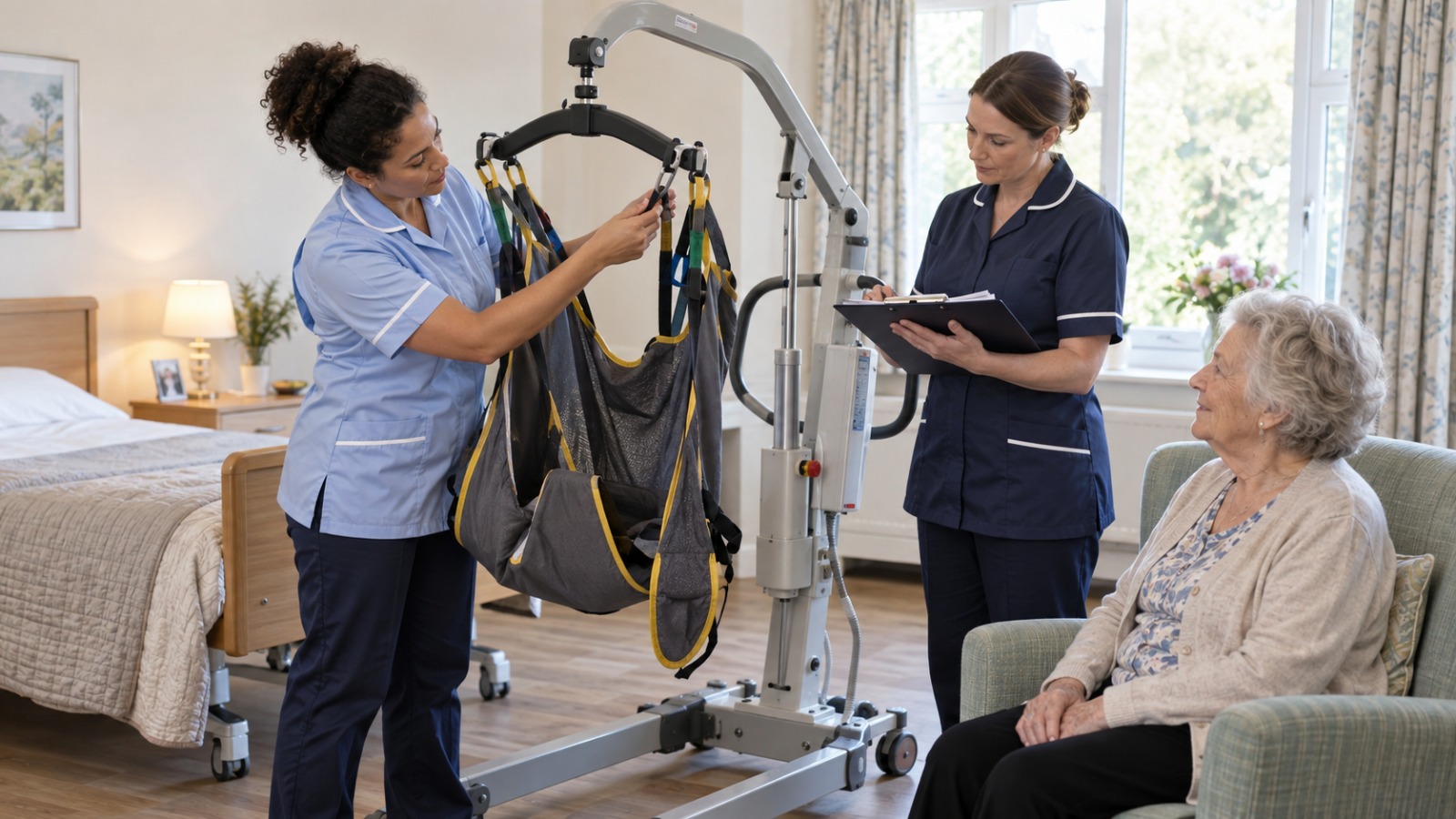
Before each transfer, staff must inspect the hoist, sling and critical attachment points in accordance with the manufacturer’s instructions for use. Checks should identify worn hooks, damaged loops, missing retaining features, incorrectly assembled components and other signs of deterioration.
After the initial load is applied—but before the person is completely lifted—staff should pause while the sling is taut and the person’s weight is only partially supported. Every sling attachment point must then be checked to confirm that it remains correctly positioned and securely attached.
If a component is damaged, missing, incorrectly fitted or otherwise unsafe, the transfer must stop. The equipment should be removed from service, clearly marked “Do Not Use” and reported through the organisation’s agreed safety procedure.
How Should Hoist and Sling Compatibility Be Confirmed?
Care workers should never assume that a sling is compatible simply because it physically fits the hoist. Compatibility should be confirmed through the manufacturer’s instructions for use. This is especially important when organisations use third-party slings or equipment supplied by different manufacturers.
The provider should maintain an accessible register of approved hoist-and-sling combinations. A person-specific moving and handling risk assessment must also confirm the correct hoist, sling type, sling size, attachments and number of staff required.
The assessment should be reviewed whenever the person’s weight, posture, cognition, pain, muscle tone, balance or ability to participate in the transfer changes.
What Does the Alert Say About LOLER and Equipment Maintenance?
Under the MHRA alert, hoists used for lifting people must receive a thorough examination by a competent person at intervals not exceeding six months. Providers must also follow the manufacturer’s servicing and maintenance instructions and keep accurate records.
A pre-use inspection does not replace scheduled servicing or a statutory LOLER examination. Any hoist with an overdue examination, unresolved defect or component that has exceeded its recommended service life should be removed from use until its safety has been properly confirmed.
The Health and Safety Executive’s moving and handling guidance also emphasises risk assessment, suitable equipment, staff training and measures to prevent injury to both workers and people receiving care.
How Does the Alert Affect Staff Training and Competency?
The MHRA requires training to reflect the actual hoists, slings, patient groups and care environments in which staff work. Training should cover pre-use inspections, equipment compatibility, correct fitting, unsafe equipment conditions, the pause-and-check procedure and when to stop and escalate a concern.
Care providers should also ensure that staff know how to report incidents and near misses through local reporting systems and, where appropriate, the MHRA Yellow Card scheme.
Online learning can strengthen essential knowledge, but it should form part of a broader training programme. Care staff must also receive practical instruction and workplace competency assessment using the equipment they are expected to operate.
What Should Registered Managers Do Now?
Registered managers should formally record receipt of the alert and identify the person responsible for coordinating its implementation. Existing moving and handling policies, individual risk assessments, staff training records, equipment inventories, compatibility information and LOLER examination dates should all be reviewed.
Managers should not wait until the September 2027 deadline to begin. The alert calls for action as soon as possible, and its published document warns that failure to complete the required actions may lead to CQC regulatory action.
Strengthen Moving and Handling Knowledge
Care organisations can reinforce staff knowledge through Learning Connect’s online moving and handling training course. The course supports understanding of safer moving practices, risk assessment and handling equipment.
However, completing an online course alone does not demonstrate practical competence. Employers remain responsible for providing equipment-specific instruction, supervision, practical assessment and refresher training appropriate to each employee’s role.